TRAINING
"Training your horse to make and keep him healthy, while ensuring that both you and your horse enjoy it, that is the art."
Perhaps you remember the first time you sat on a horse or pony. The wonderful smell of the horse, your hands in its mane, and that magical moment when your pony started moving. The feeling of being carried and at one with such a beautiful animal.
Many of us lose that magical feeling. Often, we have to compete to perform, or there's other pressure on training. These days, everything has to move fast, and that includes training a horse. However, the horse's body doesn't like to be rushed. If we try to go faster than it can handle, all sorts of injuries and behavioral problems arise.
One of the problems people often share with me is that their horse was light in the hand as a youngster, but over time, it became increasingly stiff and stronger, usually stronger on one of the two reins. Gradually, riding has become a test of strength with your horse. Your arms and shoulders ache. You might still score points at competitions, but that good feeling is gone.
How do we now return to lightness, effortlessness, and harmony? That magical feeling of working together with your horse, a spontaneous smile on your face? The feeling that all you have to do is think, and your horse will join in because your horse is strong, stable, AND gentle…
All of this happens when we allow the horse to move on its own legs. This means the horse is so balanced that it no longer needs its rider. A horse that is vertically out of balance has a three-dimensional curve in its body. Viewed from the front, this is a rotation in which the withers turn to the left or right. Viewed from the side, the horse sinks too much into the low neck and base of the back and arches slightly in the loins, creating a horizontal S-curve, which shifts the weight to the forehand. Viewed from above, there is an incorrect bend in the spine to the left or right.
This prevents a horse from relaxing because it has to keep itself upright by compensating with muscle tension. It needs its head as a counterbalance, so if its withers drop to the left and down, its head will move up and to the right. If the rider now asks the horse to "walk on the rein," it's in serious trouble, because it no longer has its head and neck to use as a counterbalance.
So what? We're going to bring the horse into vertical balance, meaning we teach it to place its torso weight precisely between its shoulder blades. This instantly eliminates all the twists in all three directions. The spine is completely straight, the horse no longer tumbles, its withers are already rising slightly, and therefore it no longer needs to use its head as a counterbalance. The result? The horse automatically takes on a forward-downward tendency and carries the rider's hand with it!
“Contact is the connection the horse makes with the rider's hand.”
Most horses learn vertical balance very quickly. It gives them a lot of comfort, so once they've got the hang of it, they'll find it themselves.
And as they get stronger, they can stabilize themselves and maintain vertical balance on their own legs. As riders, we then experience a relaxed yet active horse, moving tactfully and powerfully with a nice bounce. The horse radiates contentment, has a gentle gaze, and snorts regularly.
And then what?
Vertical balance is the first step, then we move on to lateral bending and more collection. This step is usually received less enthusiastically by the horse, as the technique is a bit of a puzzle for them, and gaining more self-carriage is hard work.
But once they master the technique and build up enough strength to do it effortlessly, they actually become very happy. The movement becomes even more balanced, light-footed, and powerful. The horse allows its body to function as a whole and begins to move like a dance. Its body becomes stable and soft, which also softens its mind.
And a mentally soft horse that moves steadily and in balance picks up on the rider's most subtle signals and responds to them effortlessly and joyfully. This creates a harmonious picture where horse and rider are one.
The 4DimensionDressage method is built step by step. It's based on biomechanics and tailored to the horse's learning ability. The puzzle pieces are first separated and trained, only to be put back together later. This way, the horse learns to gain perfect control over its own body, making it a powerful and impressive force.
The main steps are:
- Balance
- Relaxation
- Activation
- Stabilization
You repeat these steps with your horse over and over again, only each time at a higher level. Balance allows the horse to relax, but if we want to activate the horse's spring system and achieve the correct tone on the connective tissue and muscles, we must activate the horse sufficiently. This creates relaxed tension, or positive (muscle) tone. This stabilizes the horse's neck and torso and gives its legs room to move.
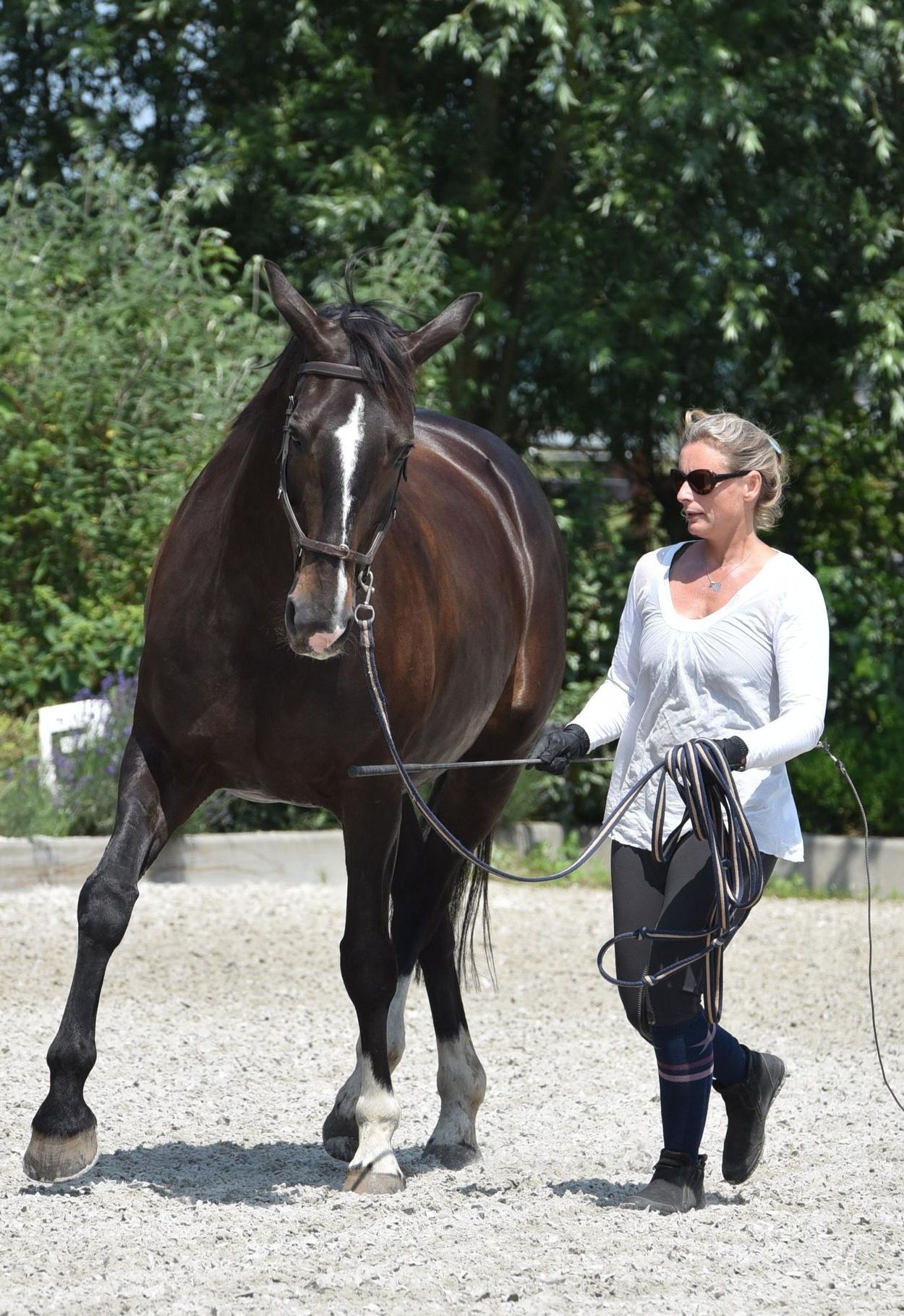
The horse learns healthy posture through the four dimensions. We also teach these separately at first:
- Vertical Balance
- Horizontal Balance
- Lateral flexion (side bending)
-Move the direction of the fore and hindquarters
These four dimensions, combined with the ability to regulate the energy, where we play between more forward and more upward energy, ensure that your horse can learn both the basics and the exercises very easily.
Every movement and every exercise is ultimately built up from the 4 dimensions and controlling energy.
This means that if your horse knows these basic principles, all exercises are very logical and you do not teach him them as a trick but as a movement technique.